Our approach
Read about our approach, objectives and principles.
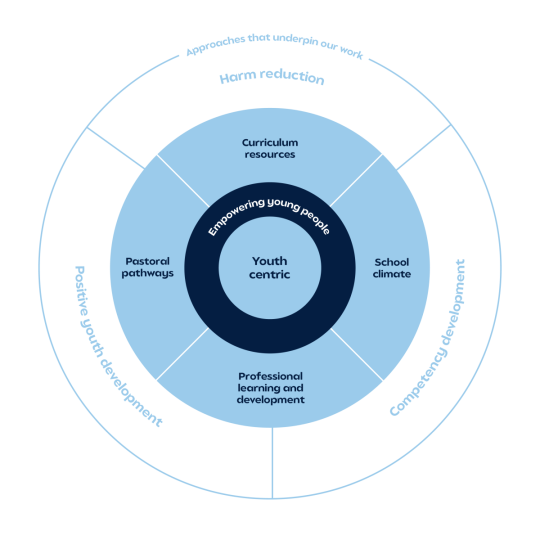
A youth-centered, harm reduction model
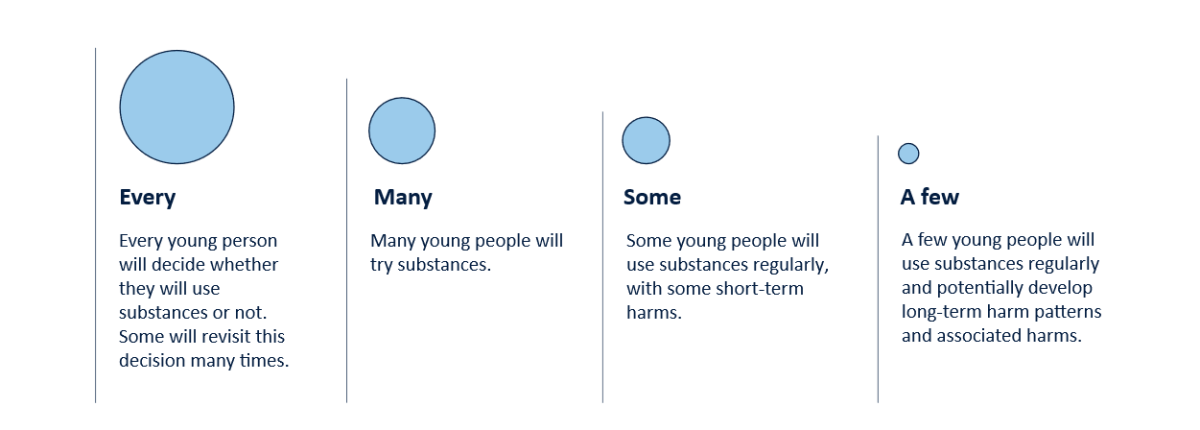
Every young person will make decisions about a range of complex issues including alcohol and other drug use, gambling, gaming and living in a digital world.
We know schools can be ecosystems of learning and support where students learn the skills they need to live healthy and successful lives.
They can also serve as anchors of support for students in need. Tūturu helps schools better prepare their students with resources that resonate with them and supporting teachers and staff with training and connections with local heath providers.
Initially, our focus was on alcohol and other drugs, aiming to help schools move away from reactive methods to proactive approaches that prepare students for the challenges of modern life. Now, we’ve broadened our focus to encompass other aspects of young people’s health such as implementing student-led action.
By fostering critical thinking skills and offering support during difficult times, we strengthen young people’s ability to navigate life’s challenges.
A whole school approach
The whole school approach places wellbeing as a key element of a young person's development and readiness to learn.
Many wellbeing issues can be addressed with an early preventative broad-based approach. Social connectedness, relationships and a sense of belonging are a strong protective factor in relation to mental health, wellbeing and the prevention of substance use.
As part of a whole school approach, we work with secondary schools on the following areas.
|
School climate
|
Supporting school leadership at the governance (School Board) and management (Senior Leadership/Principal) levels within a school environment. Enhancing pastoral care within the student support team. Providing teachers/kaiako with the necessary skills and information so that they can confidently engage with students on alcohol and other drugs (AOD). Ensuring that the school client is conducive to enhancing student hauora/wellbeing. |
|
Early identification and support
|
Assisting schools in establishing systems to identify AOD and other issues early, ensuring students receive timely support.
|
|
Increasing student engagement
|
More students remain engaged in their education, with schools relying less on stand-downs, suspensions, exclusions and expulsions as a response to AOD use.
|
|
Preparing for the future
|
Young people are better equipped for modern life, learning to critically analyse their experiences and the information they encounter.
|
|
Community involvement
|
Engaging whānau and the school community to provide comprehensive support to students. |
Our objectives
Tūturu aims to achieve the following objectives:
- Keep more students in school, with less reliance on exclusions and expulsions to address alcohol and other drug use.
- Prepare students for modern life, equipped to make sense of what they see, hear, and experience.
- Māori and Pacific students achieve equitable outcomes alongside their peers.
- Health services enhance their capacity to work with schools, whānau, and communities.
Our principles
Tūturu's approach is based on the following principles:
· Strengths-based, evidence-based, with student wellbeing central to the direction and decision making.
· Focuses on equity and achieving equitable outcomes for Māori and Pasifika students.
· Empowers education and health services to collaborate to help students learn and stay well.
· Supports schools to put systems in place to ensure AoD and other issues are identified earlier, and students receive access to support.
· Involves whānau and the school community, strengthening the support provided to students in ways.
· Is determined by and unique to each school community.
· Is shared openly and widely with the support of a range of resources that are available nationwide.
· Continues to learn, develop, and improve.
Our theory of change
We developed our theory of change together with the New Zealand Council for Educational Research (NZCER). Underpinning the theory of change are the following concepts:
- Whole school approaches are a known, effective way of supporting change in schools.
- Co-development with schools will result in increased buy-in, and the development of effective modules.
- A holistic focus on wellbeing is more effective than single focus approaches (as ways of working can be transferred, and many risk and protective factors are similar).
- Harm minimisation approached, which include preventative approaches, equip young people with the skills they need to enhance their overall wellbeing.
- Support and treatment services that are available are evidence-based and effective for young people.
An evidence-based approach
Tūturu is grounded in the latest research and continuously evolves through regular evaluations and reviews.
Read our evaluation and a selection of the evidence and research we used to create Tūturu.